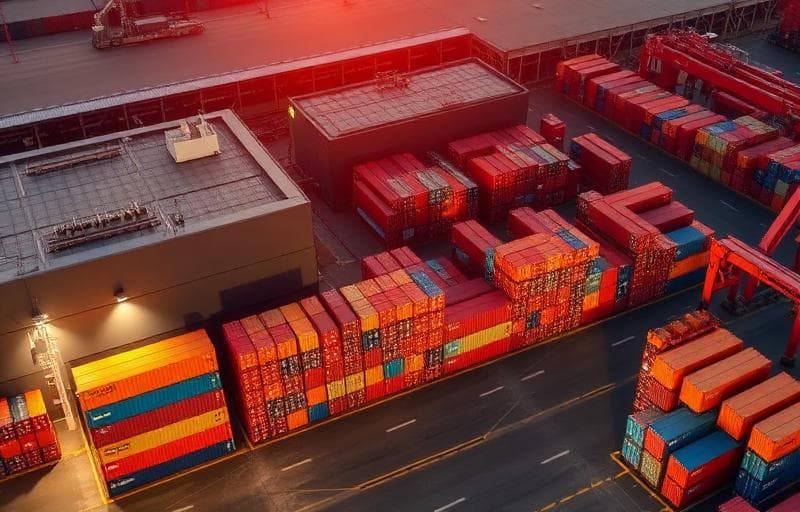
When people think about a large construction project, they usually picture the things happening at the site — cranes moving, concrete being poured, structures going up. What they don't always see is the logistics behind it. Before a project can pour concrete, the cement has to be there, arriving in the right quantity at the right time.
For a small project, moving these materials by road may be relatively straightforward. For a large infrastructure project requiring thousands of tonnes of material, it becomes a very different calculation — this is where coastal shipping can be worth considering.
For cement and construction materials, the decision isn't simply about whether a vessel can carry the cargo. The material has to be handled properly, moisture has to be controlled, storage needs to be available, and the final distance from the destination port to the project site can make a big difference to the overall economics.
Why Cement Is an Interesting Cargo for Coastal Shipping
Cement has one characteristic that makes transportation planning particularly important: large quantities are consumed continuously. A major construction project may need regular deliveries for months, running into thousands or tens of thousands of tonnes. A simplified coastal shipping movement might look like: Cement plant → Origin port → Coastal vessel → Destination port → Project. The vessel handles the long-distance portion, while road or rail handles the shorter inland movements — useful when the manufacturing plant and project are both reasonably close to suitable ports, but the route has to work end to end. Explore Astromar's coastal shipping services →A Port-to-Port Route Isn't the Whole Journey
Suppose a cement plant is 50 or 60 kilometres from a port, and the project is another 70 kilometres from the destination port. The coastal vessel covers the longest part of the journey, but the cargo still has to travel those inland distances — so the actual movement is Factory → Origin Port → Coastal Shipping → Destination Port → Project, not simply Port A → Port B.
A coastal route may look attractive when comparing only the maritime distance with the road distance. But once port handling and both road legs are included, the economics may look different — a proper route assessment should always consider the complete delivered cost.
Why Large Volumes Make Coastal Shipping More Interesting
A truck carries a limited quantity; a vessel can carry a much larger volume in one movement. A project needing several thousand tonnes of cement over a period could mean a substantial number of individual truck trips — a coastal vessel can consolidate a large quantity into one movement or a planned series of movements.
That doesn't mean the vessel is automatically cheaper. There are port charges, handling costs and inland transportation to factor in. But when the cargo volume is large enough, the long-haul portion of the journey can potentially be handled more efficiently, which is where coastal shipping starts to make commercial sense.
Cement and Moisture Don't Mix
Cement needs water during construction — it does not need water while sitting in storage. Exposure to moisture can affect the material and reduce its usability, so protection has to be considered throughout the journey, not just while the cement is on the vessel: Factory → Loading → Port → Vessel → Unloading → Storage → Road Transport → Site.
For bulk cement, this may involve properly designed silos and transfer systems. For bagged cement, packaging, stacking and warehouse conditions become important. The logistics model has to reflect the actual form in which the cement is being transported.
Bulk Cement Needs a Different Setup
There's a big difference between moving cement in bags and moving it in bulk. Bulk cement usually requires specialised infrastructure — at the destination, cargo may need to be unloaded and transferred into silos before being sent to the project in bulk tankers: Vessel → Unloading system → Silo → Bulk tanker → Construction site.
If that infrastructure isn't available, the coastal route may become less attractive. The same applies at the origin — a cement plant connected efficiently to the port and equipped for the required loading operation can make a coastal movement much easier to execute. This is why port infrastructure should be considered before the freight rate.
Bagged Cement and Clinker
Bagged cement may appear easier because it doesn't require the same bulk handling equipment, but storage and handling still matter — bags need to remain protected from moisture, stacked appropriately, and handled carefully to reduce damage during repeated movement.
Clinker is another important cargo to consider, produced during cement manufacturing and later ground to produce cement. A company may have clinker production in one location and grinding facilities in another — if both have suitable port access, coastal shipping can potentially form part of the movement between them. The same principle applies: large volume plus suitable port access plus appropriate handling infrastructure equals potential coastal-shipping opportunity, though actual economics still need to be checked for each route.
Construction Materials Go Beyond Cement
Once a company starts looking at coastal shipping from a supply-chain perspective, other materials come into the discussion — limestone, aggregates, fly ash, gypsum and steel products, depending on cargo and available infrastructure. But each behaves differently: steel has different storage and handling requirements from cement, aggregates have different loading considerations, and fly ash may need specialised handling.
There isn't one standard coastal-shipping solution for construction materials — the cargo determines the logistics model.
The Last 100 Kilometres Can Change the Economics
Imagine two destination ports: Port A is 80 kilometres from the project, Port B is 350 kilometres away. Even if Port B offers a better coastal freight rate, the additional inland transportation may eliminate the advantage.
This is why the destination port needs to be selected based on the final customer or project location, not simply the vessel route. The question should be how much it will cost to get the material all the way to the site — not how much it costs to move the material between the ports.
Construction Projects Need Reliability
Cost is important, but construction companies also care about something else: will the material arrive when it's needed? A delay in cement supply can affect concrete work, a shortage of steel can affect fabrication, and a delayed shipment can hold up an entire sequence of activities.
The cheapest transport option isn't necessarily the best option — a coastal shipping plan needs to fit into the project's consumption schedule. If the site consumes 500 tonnes a week, the logistics team needs to understand how much should arrive at each stage and how much buffer inventory is appropriate. Planning several weeks or months ahead, rather than waiting until the site is running low, gives the logistics team far more options.
Storage Is Part of the Transportation Plan
A vessel can deliver a large quantity at one time — but can the project receive it? Suppose a vessel brings 5,000 tonnes of material, but the project site can only accommodate 1,000 tonnes. The remaining material needs somewhere to go.
For bulk cement, suitable silo capacity may be required. For bagged materials, warehouse or covered storage may be needed. If storage isn't available, the company may end up paying for additional handling or temporary arrangements — storage isn't a separate issue, it's part of the coastal-shipping plan. The best inventory level depends on the project's consumption rate, shipment frequency and expected transit time.
Where FTWZ Can Come Into the Picture
For certain eligible imported goods and transactions, an FTWZ can potentially form part of a wider supply-chain strategy. The role is different from coastal shipping — coastal shipping moves cargo between ports, while an FTWZ can provide a location for managing eligible imported inventory within the permitted framework.
Consider a company that imports construction-related materials and supplies several projects — not everything that arrives today necessarily needs to be sent to a project today. Depending on the goods and transaction structure, the company can evaluate whether an FTWZ model provides a useful way to manage that inventory before domestic distribution. It's not automatically the right option, but it's worth considering when the business has substantial imported inventory and a more flexible distribution requirement. What Makes a Coastal Route Work Well?
Several conditions can make a route more attractive: large cargo volumes, good port connectivity from the manufacturing facility, a suitable destination port with required handling facilities, available storage after unloading, regular predictable project demand, and a reasonably short final-mile distance from the destination port.
A coastal route may not work as well if the cargo volume is too small, the origin or destination is far from the port, suitable unloading facilities are unavailable, storage capacity is limited, or vessel schedules don't match project requirements. In those situations, direct road transportation may simply be easier — the objective is to choose the mode that works for the particular cargo and route, not to use coastal shipping because it sounds efficient.
Weather, Vessel Schedules, and the Environmental Angle
Unlike a truck on a highway, a vessel operates within a maritime and port environment where weather can affect movements and schedules can change. For a construction project, that means some level of planning buffer may be sensible — building appropriate buffer into the supply plan rather than holding huge quantities of inventory.
There's also a wider sustainability angle. Shifting part of a long-distance movement from road to coastal shipping can potentially reduce road transportation required, but the environmental impact depends on the complete journey — if the destination port is extremely far from the project, the additional road distance may reduce the benefit.
A Simple Example
A construction project needs a steady supply of cement from a manufacturing location on the western coast, with reasonable port access at both ends. Instead of moving all the cement by long-distance road, the company could evaluate: Cement plant → Short road movement → Origin port → Coastal vessel → Destination port → Storage or silo → Short road movement → Project site.
The company would then compare this with the direct road option across freight, port handling, inland transport, storage, transit time and reliability. If the numbers and operating conditions work, coastal shipping may be a sensible part of the supply chain — if they don't, road transport may remain the better option.
Planning Should Start Before the Cargo Is Produced
The better approach is to start with the project schedule: how much material will the project consume each month, when will demand increase, how much storage is available, how frequently can vessels be scheduled, and how much buffer inventory is needed?
This is particularly important for large projects because material requirements can change as construction progresses. A cement shipment doesn't exist on its own — it's part of a much larger network connecting the manufacturer, the port, storage, transporters and the construction team's delivery schedule.
Final Thoughts
Coastal shipping for cement and construction materials isn't about replacing trucks completely — it's about using the sea where the sea makes sense. For a large-volume movement over a long distance, a coastal vessel can potentially handle the middle section of the journey more efficiently than sending hundreds or thousands of individual truckloads. But that advantage only works when the rest of the chain is planned properly — port access, correct handling, moisture protection, and a reliable final connection to the project.
The best coastal-shipping plan isn't necessarily the one with the cheapest vessel rate. It's the one that delivers the material to the project at a competitive total cost, with the right level of reliability. For businesses handling imported construction materials, an FTWZ can also be considered as part of the wider supply chain strategy for eligible goods and transactions.
Astromar Logistics Pvt. Ltd. has been operating since 2017, running a network of 10 FTWZ locations with 2 Lakh+ sq ft of warehousing, 10K+ sq ft of cold storage, 5K+ pallet positions and 500+ clients. For businesses managing construction materials and other cargo, this network can support broader supply chain planning involving warehousing, inventory positioning, customs clearance and multimodal distribution.
Ultimately, the question isn't whether coastal shipping is always better than road transport. It's simpler: for this cargo, this volume, this route and this project, what is the smartest way to move the material? Related Topics
coastal shipping cement Indiaconstruction materials coastal shippingbulk cement transportationclinker coastal shippingcement logistics IndiaFTWZ construction materials
Need FTWZ Warehousing or Freight Support?
Talk to our logistics experts — free consultation, no commitment.