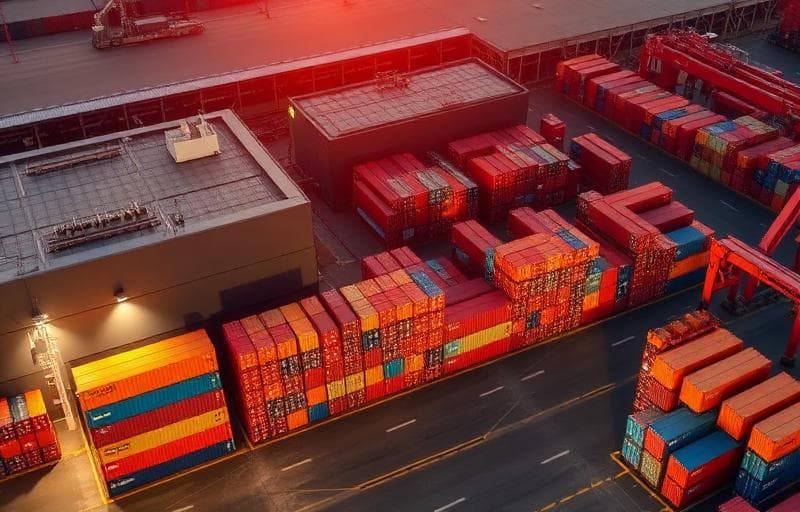
A container full of furniture can look pretty ordinary when it arrives at an Indian port — dining tables, chairs, cabinets, mirrors, lamps or decorative pieces sitting together, ready to move to a warehouse. But for the importer, this is where the real work begins.
Furniture is not always as simple to import as it looks. A dining table might arrive completely assembled. Another may come as a flat pack with separate legs, panels, screws and fittings. A home décor shipment might have glass, ceramic, metal and wooden products packed into the same container — so while it may be one shipment, it can represent dozens or even hundreds of different products.
That's what makes customs clearance for furniture imports slightly different from handling a single standard commodity. The importer has to get the product descriptions right, understand the applicable classification, keep documentation consistent, and make sure the goods are ready for the next stage — and furniture takes up space, which matters throughout the entire journey.
Furniture Isn't Just Furniture
Imagine an importer brings in a container from Vietnam containing dining tables, chairs, side tables, cabinets, mirrors, decorative shelves, metal frames, cushions and hardware. Suddenly the shipment looks very different from a customs and warehouse perspective than a simple container of 300 dining chairs.
Different products may have different materials, specifications and classifications — some finished, some parts or components. This is why furniture importers need to look beyond the simple description of "home furniture" when preparing their import documentation. The more varied the shipment, the more important accurate information becomes.
Why Flat-Pack Furniture Is So Common
Knock-down or flat-pack furniture can be much easier to transport because the products occupy less space before assembly — a wardrobe that would take up considerable room when assembled can be packed into several relatively flat cartons. The same applies to tables, beds, bookshelves, cabinets and office furniture.
For the importer, the shipment needs to be understood properly. A flat-pack wardrobe isn't simply one large object — it may consist of multiple panels, fittings, hinges and handles. The commercial documents should accurately describe what's being imported. If the paperwork is vague while the physical shipment is highly detailed, questions can arise during clearance.
The Container May Reach Its Volume Limit Before Its Weight Limit
Take two containers: one with dense industrial components, one with furniture. Both might weigh 15 tonnes, but the furniture could occupy considerably more physical space — furniture is often bulky rather than extremely heavy.
This affects the entire logistics calculation. Freight cost is important, but so are container utilisation, carton dimensions, warehouse capacity, truck capacity and handling requirements. For furniture importers, cubic volume can be just as important as weight.
Packaging Can Make or Break the Shipment
Furniture can survive a long ocean journey and still arrive with a damaged corner, a scratch, a cracked glass top, or a finish damaged from rubbing against another piece. For an industrial product, a small cosmetic issue might not be significant — for a piece of furniture being sold to a customer, it can be a major problem.
Flat-pack furniture is often protected with combinations of cardboard, foam and plastic wrapping — the objective isn't just to prevent breaking, but to protect the finish. Asking suppliers for packaging details and photographs before the first shipment can be surprisingly useful.
Mixed Materials Make Things More Interesting
A coffee table might have a wooden top, metal legs and a glass shelf. A sofa could have a wooden frame, metal springs, foam and fabric. To the customer, it's one product — for customs purposes, the characteristics of the product matter.
Importers shouldn't make assumptions about classification simply by looking at the dominant material. The actual product, its function and the applicable tariff provisions need to be considered. Where there's uncertainty, getting the classification reviewed before the shipment arrives is usually much better than resolving it while the container is waiting for clearance.
HS Classification: The Part Importers Shouldn't Guess
Furniture covers a wide range of products, and not everything that looks like furniture will necessarily fall under the same classification — a wooden table, metal furniture, specialised furniture and furniture components can have different considerations.
The safest approach is to identify the actual product characteristics and obtain appropriate customs advice where necessary. Guessing a classification because "we used the same code last time" can create problems when the product has changed.
Your Invoice and Packing List Should Tell the Same Story
Suppose the invoice says "Home furniture – 500 pieces," while the packing list shows 100 chairs, 50 tables, 80 cabinets, 120 shelves and 150 decorative units. The two documents technically relate to the same shipment, but the picture isn't very clear.
Good documentation should make it easy to understand what's actually being imported — product descriptions, quantities and package counts should be consistent across documents, especially important when a container contains a large number of SKUs. A few small inconsistencies can turn into unnecessary questions later.
Why the Packing List Matters More Than People Think
For a furniture shipment, the packing list is extremely useful for everyone handling the cargo — product description, quantity, number of cartons, package numbers, gross and net weight, dimensions and container number.
The exact requirements depend on the shipment and applicable regulations, but from a practical standpoint, the packing list helps answer a very basic question: what exactly is inside this container? That information becomes useful at customs, at the warehouse and later during distribution.
Sourcing Furniture From Vietnam and China
China and Vietnam have become important sourcing destinations for furniture and home-related products. But the purchase doesn't end when the supplier confirms the order — the shipment still has to move through Factory → Export Documentation → Port → Ocean Freight → Indian Port → Customs Clearance → Warehouse → Distribution. Each stage affects the next.
A supplier may offer an attractive product price, but if the cartons are oversized, packaging is weak or documentation keeps changing, the final logistics cost can be very different from what was originally expected. This is why the supplier decision should include logistics considerations as well. See how Astromar handles customs clearance →Container Planning Starts at the Factory
Furniture importers often focus on price per unit — but another number matters just as much: how many units can actually fit into a container? Supplier A sells a chair for slightly more but can load 500 chairs into a container; Supplier B offers a lower price but can load only 400. The cheaper chair isn't necessarily cheaper after freight is included.
Container utilisation can make a meaningful difference when the product is bulky. Good packaging design can sometimes make the difference between an efficient shipment and an expensive one.
What Happens When the Shipment Reaches India?
Once the container arrives at the Indian port, the importer moves into the customs-clearance stage. The relevant import documentation needs to be submitted, and the goods need to be declared appropriately — some shipments move through without significant intervention, while others require clarification or additional supporting information.
If the importer has already checked the product descriptions, documents and classification, the clearance process is generally easier to manage than trying to understand everything after the container has arrived.
Don't Assume Every Home Décor Product Has the Same Requirements
"Home décor" is a very broad category — a wooden decorative shelf is one thing, a glass mirror is another, an electric lamp is something else entirely. Products containing particular materials or components may have additional regulatory considerations.
If a company imports 200 different home décor products, it may be worth categorising them before the first shipment arrives, making it easier to identify which products need additional attention.
Wooden Packaging Can Also Matter
Furniture shipments may use wooden pallets, crates or other wood packaging. International movement of wood packaging can involve phytosanitary requirements under standards overseen in India by the Directorate of Plant Protection, Quarantine and Storage, based on international ISPM 15 standards.
The importer should make sure overseas suppliers understand the requirements that apply to the shipment. It's a relatively small detail compared with the value of a container full of furniture — but small details are often what cause avoidable delays. What Happens After Customs Clearance?
The container may move to a warehouse, and individual products could eventually go to retail stores, dealers, e-commerce fulfilment centres, interior designers, commercial projects or direct customers. The importer needs a storage and distribution plan before the goods arrive — otherwise, a container that has successfully cleared customs can still create a problem if the warehouse simply doesn't have enough room.
Furniture Warehouse Planning Is Different
A warehouse storing furniture cannot always be planned by looking at pallet numbers alone. Two products weighing 20 kg each may need very different warehouse space — one fits comfortably into a small carton, the other could be a large flat-packed wardrobe.
Furniture businesses therefore need to look at weight plus dimensions plus volume plus stackability rather than weight alone — particularly important when the business has a large number of SKUs.
Flat-pack furniture has a useful storage advantage: it can usually be stored more efficiently than assembled furniture. But cartons need to be stored correctly — some can be stacked, others cannot, some panels tolerate pressure while others can warp. Warehouse teams need to understand the packaging and stacking instructions rather than treating every carton the same way.
Inventory Can Become a Bigger Problem Than Customs
For a furniture retailer, the customs process may take days, but the inventory may remain in the warehouse for months. Imagine importing 1,000 dining chairs — they arrive successfully, but only 200 sell in the first month. Where are the other 800?
If the business doesn't have good supply chain visibility, the warehouse slowly becomes a place where products are stored rather than a system that supports sales. Good inventory management should tell the business what's arrived, what's available, what's sold, what's reserved, where each SKU is located, and what needs replenishment — particularly valuable when the business imports regularly. Could an FTWZ Be Useful for Furniture Importers?
This is where the conversation moves beyond customs clearance and into supply chain planning. An FTWZ can be considered for eligible imported goods and transactions, subject to the applicable customs and trade framework. Instead of automatically moving everything into domestic inventory as soon as it arrives, a business may evaluate whether eligible goods can be held within an FTWZ arrangement before being released according to the permitted process.
This can be relevant for businesses that import in large quantities, have long sales cycles, serve multiple markets, or want a more structured inventory model. But an FTWZ is not a magic solution — the commercial model still needs to make sense. Consider a Furniture Importer With a Four-Month Sales Cycle
A furniture company imports 1,000 chairs from Vietnam because the supplier requires a sizeable order. The importer knows it will probably sell those chairs over the next four months. The container arrives in India — does it clear the entire quantity and move everything into its domestic warehouse, or is there another permitted structure that could better match the timing of its inventory requirements?
For eligible goods and transactions, an FTWZ can be evaluated as one possible option. The bigger question isn't simply about storage — it's whether the inventory can be positioned in a way that matches the company's sales cycle and distribution strategy. The right answer depends on the individual business.
Don't Confuse FTWZ With "Duty-Free"
An FTWZ should not simply be described as a place where imported furniture becomes "duty-free." The applicable customs treatment depends on the goods, transaction and regulations. For businesses considering FTWZ warehousing, the better question is: can this structure help us manage when and how eligible imported inventory enters the domestic supply chain? The financial impact should then be calculated alongside storage, handling, transportation and compliance costs.
What About Distribution Across India?
Furniture businesses rarely sell in only one city — a company importing into India may eventually serve customers across Chennai, Bengaluru, Hyderabad, Mumbai, Delhi and other markets. If inventory is spread across too many warehouses, the company can end up with excess stock in one location and shortages in another. Keeping everything in one location may increase delivery distances instead.
There's no universal answer — the best model depends on where customers are, how quickly they need delivery, and how frequently inventory moves. This is why customs planning and supply chain planning should happen together.
The Real Cost of a Furniture Import
The purchase price is only the beginning. The business may need to account for product cost, ocean freight, insurance, applicable customs duties, port and handling costs, warehouse cost, domestic transportation and distribution. The final landed cost is what matters — a cheaper product isn't necessarily the better purchase if it requires more expensive freight, uses excessive packaging or creates higher storage costs. A Better Approach Before the Container Leaves
Furniture importers can avoid many problems by asking the right questions early: What exactly is being shipped? How many SKUs are there? What are the carton dimensions and total volume? What materials are being used? How are products packed? Does the invoice match the packing list? Has the HS classification been reviewed? Where will the cargo go after clearance?
Answering these before the vessel sails is much easier than answering them while the container is sitting at the port.
The Supplier Is Part of Your Customs Process
Customs clearance isn't entirely the importer's responsibility — the overseas supplier plays a major role. If the supplier sends incomplete information, changes product descriptions or provides poor packaging, the importer has to deal with the consequences.
A good importer-supplier relationship should include documentation standards: product names, SKU numbers, quantities, carton counts, dimensions, gross and net weights, material information, country of origin and packaging details, consistently provided for every shipment.
Final Thoughts
Furniture imports sit at the intersection of several logistics challenges — bulky products, mixed materials, careful packaging requirements, different classification considerations, and significant warehouse space for months after arrival.
That's why a furniture importer shouldn't treat customs clearance as an isolated step. Before the container leaves Vietnam or China, the importer should already have an idea of what's coming, how it's packed, how it will be classified, where it will be stored and how it will eventually reach customers. For businesses importing at scale, an FTWZ can also be evaluated as part of that wider strategy for eligible goods and transactions.
Astromar Logistics Pvt. Ltd. has built a network of 10 FTWZ locations offering 2 Lakh+ sq ft of warehousing, 10K+ sq ft of cold storage and 5K+ pallet positions, serving 500+ clients since 2017. For furniture and home décor importers, this network can be considered as part of a broader supply chain strategy covering inventory positioning, warehousing, transportation and customs clearance.
Supplier → Port → Customs Clearance → Warehouse → Distribution → Customer. When those stages are planned together, the process becomes much easier to control — and for an importer, that can mean fewer surprises, better inventory visibility and a more predictable cost from the moment the furniture leaves the factory until it reaches the customer. Related Topics
furniture import customs clearance Indiahome decor import documentationflat pack furniture HS codefurniture warehousing Indiawooden packaging import rulescustoms clearance
Need FTWZ Warehousing or Freight Support?
Talk to our logistics experts — free consultation, no commitment.