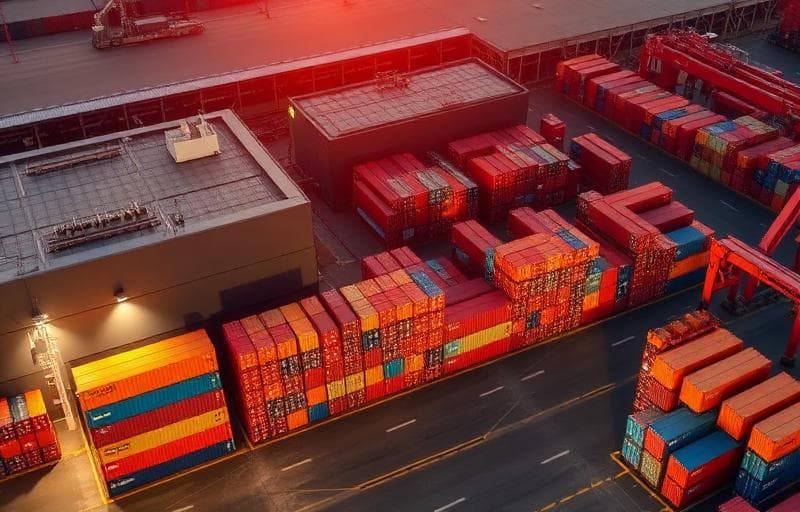
For companies operating in chemicals and petrochemicals, logistics is rarely just about moving cargo from one location to another — the more difficult question is often where imported material should sit between arrival and final use. A chemical manufacturer may import raw materials but not require the entire shipment immediately; an exporter may receive finished chemical products in bulk but need to hold them before sending smaller consignments to different overseas markets. In both situations, paying import duties immediately and maintaining separate logistics arrangements can put unnecessary pressure on working capital. This is where a Dahej FTWZ becomes strategically useful — Dahej is already deeply integrated into India's chemical and petrochemical industrial ecosystem, with the Dahej PCPIR covering a 453 sq km area focused on refinery downstream products, high-performance chemicals, pigments, and coatings, alongside India's first dedicated chemical port, operational since 2001.
Why Dahej Is Different for Chemical Logistics
The logistics requirements of a chemical business differ from those of a conventional importer. A shipment may involve chemical raw materials, petrochemical feedstock, solvents, polymers and additives, chemical intermediates, specialty chemicals, finished chemical products, temperature-sensitive materials, or hazardous and regulated cargo — and the cargo itself may not be the only challenge. Companies also have to consider customs documentation, storage compatibility, packaging, safety requirements, inventory visibility, and the timing of domestic clearance or re-export. Dahej's industrial ecosystem makes the region particularly relevant for these requirements, meaning a company importing chemicals into India doesn't necessarily need to treat the port as the end of its logistics process — instead, the movement can be structured around an FTWZ: International Supplier → Indian Port → FTWZ → Domestic Customer / Manufacturing Unit / Re-export Market. The FTWZ becomes the controlled point where inventory can be stored, consolidated, documented, and subsequently moved according to the company's commercial requirement.
Dahej →What a Dahej FTWZ Can Do for Chemical Importers
Consider a chemical manufacturer importing 500 tonnes of a particular raw material that isn't all needed immediately. If the cargo is brought into the domestic market at once, the company may have to account for applicable customs duties at the point of clearance, even though a significant portion may remain unused for months. An FTWZ provides another way of structuring that inventory — instead of immediately clearing the complete quantity, eligible goods can be moved into the FTWZ and managed there, with subsequent clearances planned according to actual requirements: Month 1, 500 tonnes arrive and the complete shipment is received and stored; Month 2, 100 tonnes are required for production; Month 3, another 75 tonnes; Month 4, 150 tonnes; the balance retained for future requirements or potentially re-exported, subject to applicable procedures. The commercial advantage isn't simply cheap storage — it's inventory timing, giving the company greater control over when goods enter the domestic market and when the associated customs liabilities arise.
Chemical Warehousing Requires More Than Floor Space
One of the common mistakes in warehouse selection is comparing facilities only on square footage — chemical logistics requires a much broader assessment based on the characteristics of the cargo and applicable regulatory and safety requirements. Relevant questions include the chemical classification, whether the cargo is hazardous, storage compatibility requirements, temperature control needs, packaging, restrictions on co-storage, required handling equipment, accompanying documentation, applicable fire and safety measures, and how quickly cargo can be dispatched when required. This is particularly important for hazardous or regulated cargo, where the warehouse operator, importer, customs broker, transporter, and cargo owner need to work from the same operational plan — a facility may have adequate physical capacity but still be unsuitable for a particular chemical product if the required permissions, infrastructure, or handling capabilities aren't in place. Chemical warehousing in Dahej should therefore be evaluated as an integrated logistics capability rather than simply a storage service.
Where Duty Deferral Becomes Commercially Important
The strongest reason companies consider FTWZ operations is often the ability to manage the timing of customs duty and tax exposure — particularly relevant when imported goods aren't intended for immediate domestic consumption. Imagine an international trader importing specialty chemicals in bulk for customers across India whose demand fluctuates: clearing the entire shipment immediately can create a mismatch where cargo has arrived but customers aren't ready to receive it, effectively converting the entire shipment into domestic inventory before commercial demand has materialised. With an FTWZ model, eligible goods can instead remain within the FTWZ framework until the importer decides how and when to proceed — supporting better working-capital management, inventory postponement, consolidated imports, customer-specific dispatch planning, re-export opportunities, and more flexible distribution planning. The objective isn't to avoid customs obligations, it's to align the timing of customs clearance with the commercial movement of the goods, wherever regulations permit.
Bringing Freight, Warehousing and Customs Together
Chemical logistics becomes complicated when every activity is handled independently — one company arranges international freight, another coordinates port movement, a third handles warehousing, a customs broker manages documentation, and a transporter moves cargo to the customer, leaving the importer to coordinate all of them. This fragmented model can work, but it creates more points where information can be lost. A more integrated supply chain approach connects freight movement, FTWZ storage, inventory management, and customs processes into one visible sequence: supplier booking, ocean freight, port arrival, FTWZ movement, customs documentation, warehousing, inventory control, customer-specific clearance, and final delivery. The advantage is operational visibility — instead of asking five different service providers where a shipment is, the logistics team works with one coordinated process, which becomes particularly important when shipments involve multiple SKUs, different customers, or batch-level inventory.
supply chain →Consolidation Can Change the Economics
Another area where FTWZ operations become useful is consolidation. Suppose an Indian chemical distributor purchases products from four international suppliers — instead of managing four independent domestic distribution flows, the company can use the FTWZ as a central inventory point, with cargo arriving from different suppliers, received and stored, then dispatched according to customer requirements. The same principle works in reverse: an exporter may collect products from different Indian suppliers and consolidate them before exporting a larger shipment, simplifying logistics planning and potentially improving container utilisation. For international traders, the FTWZ becomes more than a warehouse — it functions as a trade and distribution node. A conventional warehouse answers "where do we keep the goods?" An FTWZ answers a broader question: how should the movement, storage, clearance, and onward distribution of these goods be structured?
Customs Clearance for Chemical Cargo Needs Careful Planning
Chemical shipments can become particularly sensitive at the customs stage — documentation has to accurately represent the cargo, while classification, valuation, and licensing may need assessment depending on the product. For businesses handling chemical imports, customs clearance shouldn't be treated as a final administrative step after cargo arrives — it should be incorporated into the logistics plan from the beginning. Before shipment, companies should establish product description and technical specifications, correct HS classification, applicable import requirements, required licences or approvals, Safety Data Sheets, packaging and labelling requirements, country-of-origin documentation, commercial invoice and packing list, transport documentation, FTWZ movement requirements, and a final clearance or re-export strategy. This is particularly important for hazardous and regulated chemicals, since a documentation problem can quickly become an operational one — cargo may be physically available but commercially unusable until it's resolved. For logistics managers, the lesson is simple: customs planning should begin before the container reaches the port.
customs clearance →What About Re-Exports?
Dahej's location is also relevant for companies using India as a regional distribution base — not every imported chemical product entering India is necessarily intended for Indian consumption. A trader may import material into India and subsequently sell it to customers in Southeast Asia, the Middle East, or other international markets. In such cases, an FTWZ can provide a controlled environment for holding inventory before re-export, subject to applicable customs and FTWZ procedures — an alternative to clearing goods into the domestic market only to export them again later. For international traders, that can simplify inventory strategy and reduce unnecessary domestic movement, supporting the broader concept of using India not only as a consumption market, but as a potential regional trade and redistribution hub.
Cold Storage and Temperature-Sensitive Chemicals
Not all chemical products can be treated as ambient cargo — certain products have defined temperature or environmental storage requirements, making warehouse selection even more important. The decision should consider required temperature range, monitoring and recording, backup systems, product compatibility, loading and unloading procedures, power reliability, emergency response, packaging integrity, and stock rotation requirements. Cold storage can also become relevant to chemical and pharmaceutical supply chains where temperature-sensitive materials require controlled handling — with 10K+ sq ft of cold storage capacity, the wider Astromar network is positioned to support temperature-sensitive logistics requirements where the specific product, facility, and regulatory requirements are compatible. However, cold storage should never be assumed to mean every temperature-sensitive or hazardous product can automatically be stored in the same facility — product-specific technical and regulatory assessment remains essential.
How to Decide Whether an FTWZ Makes Sense
An FTWZ isn't automatically the best answer for every chemical importer — the business case should be evaluated against the company's actual cargo profile. An FTWZ can be particularly relevant for companies with high-value imported inventory, significant customs-duty exposure, long inventory holding periods, variable customer demand, multiple international suppliers or domestic customers, re-export or consolidation requirements, seasonal demand, or a need to postpone domestic clearance. On the other hand, if a company imports small quantities immediately consumed in production, the additional FTWZ process may not always create enough commercial value. The right question isn't "is an FTWZ cheaper than a normal warehouse" — it's whether an FTWZ can improve how the company manages inventory, customs exposure, and international trade. That's a much more meaningful business calculation.
A Network Approach Instead of a Single-Warehouse Strategy
For companies operating nationally, the advantage of an FTWZ network becomes even more relevant. Astromar operates across 10 FTWZ locations, with 2 Lakh+ sq ft of warehousing, 10K+ sq ft of cold storage, 5K+ pallet positions, and supports 500+ clients, with operations dating back to 2017. The purpose of multiple locations isn't simply to provide more warehouse space — it lets businesses consider where inventory should sit in relation to ports, manufacturing clusters, customers, and distribution routes. A chemical company importing through Gujarat may have one requirement; a company importing through JNPA, Chennai, or another gateway may have another. Instead of forcing every shipment through the same logistics structure, businesses can evaluate the location based on their actual trade flow — particularly relevant for companies operating across multiple Indian manufacturing and consumption markets.
The Bigger Opportunity for Dahej-Based Chemical Businesses
Dahej's industrial ecosystem continues to make it an important location for chemical and petrochemical activity — a dedicated petroleum, chemicals and petrochemicals investment area, with clustering benefits created by sector-specific industrial estates and supporting infrastructure. For businesses operating within that ecosystem, logistics decisions increasingly need to consider more than transportation cost: where should imported inventory be held, when should it enter the domestic market, can multiple shipments be consolidated, can excess inventory be redirected to another customer, and can customs, warehousing, and transportation be coordinated under one operating model? An FTWZ can provide part of the infrastructure needed to answer those questions — the real value comes from designing the entire movement around the company's trade requirements. A well-planned FTWZ model can help businesses manage imported inventory, postpone domestic clearance where permitted, consolidate cargo, support re-export operations, and coordinate customs with physical logistics. For importers, exporters, and international traders operating in this sector, the question is no longer simply where to store chemical cargo — it's how to position inventory so that customs, cash flow, warehousing, and distribution work together. That's where an integrated Free Trade Zone strategy can create practical value.
Free Trade Zone →Related Topics
dahej ftwzchemical warehousing dahejpetrochemical import export indiaduty free chemical storagebonded warehouse gujarat chemicalsdahej pcpir logisticshazardous cargo warehousing india
Need FTWZ Warehousing or Freight Support?
Talk to our logistics experts — free consultation, no commitment.