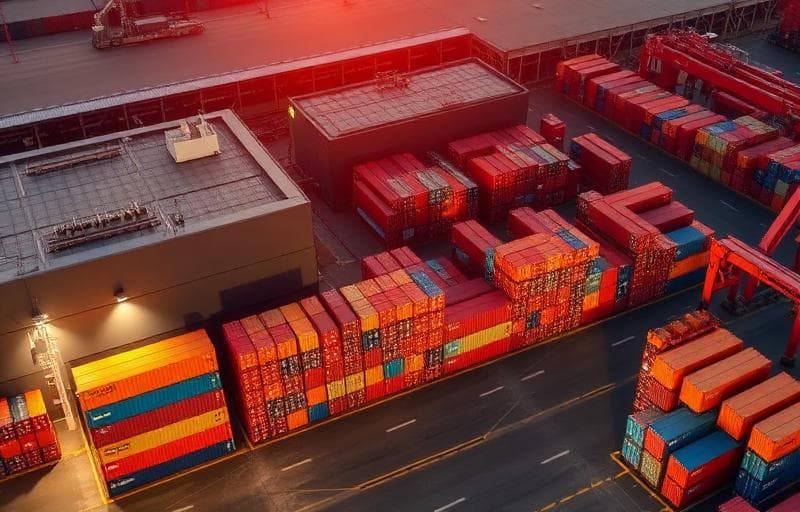
Walk into an FMCG warehouse and you quickly realise that the challenge isn't simply the amount of stock sitting inside — it's the variety. There may be hundreds of products on the same floor, each with its own SKU, pack size, flavour, batch, customer requirement or promotional configuration.
For an importer serving customers across several Indian markets, this creates a deceptively difficult logistics problem. You need enough stock to keep customers supplied, but you don't want to tie up too much money in inventory. You want products close enough to customers for efficient delivery, but spreading the same products across several warehouses can create duplicate stock and make inventory harder to manage.
This is where multi-SKU consolidation becomes useful. For some businesses, an FTWZ can form part of that strategy by providing a place to manage eligible imported inventory before it's released into the domestic market or distributed further. But the warehouse itself isn't the strategy — the real strategy is deciding where inventory should sit, how much should be held, and when it should move.
Why FMCG Supply Chains Get Complicated So Quickly
FMCG businesses often deal with products that move in relatively small individual quantities but in very large overall volumes — different bottle or packet sizes, multiple flavours or variants, retail and wholesale packaging, promotional packs, seasonal products. Each variation can become a separate SKU.
Now imagine managing 500, 1,000 or even several thousand SKUs. The challenge becomes much bigger than finding enough floor space — the warehouse needs to know exactly what has arrived, where it's stored, how much is available, which batch it belongs to and where it needs to go. That's why FMCG warehousing is fundamentally an inventory-management problem, not just a storage problem.
What Multi-SKU Consolidation Actually Means
Multi-SKU consolidation is essentially about managing different products through a common inventory and distribution structure instead of creating a completely separate logistics chain for every product or supplier. Without consolidation, the network might look like Supplier A → Warehouse A → Customers, Supplier B → Warehouse B → Customers, and so on separately.
With a consolidated model, the importer could instead evaluate: Multiple Suppliers → Port → Consolidated Warehouse / FTWZ → Multiple Markets. The products remain separately identifiable and properly controlled inside the warehouse — consolidation simply means the business is managing them through a common logistics structure, which can make a significant difference when customer demand is spread across several markets. Why Businesses Don't Always Need a Warehouse in Every City
It's easy to assume the more warehouses a business has, the better its distribution will be. That isn't necessarily true. Suppose an importer sells products in five states and carries 1,000 SKUs — if the company keeps the same products in five different warehouses, it may need safety stock for each location, with one warehouse having plenty of a particular SKU while another has almost none.
The company may then have to move stock between warehouses even though total inventory is sufficient, creating additional transportation and handling costs and making inventory visibility harder. A consolidated inventory base can sometimes solve part of this problem by allowing stock to be allocated according to actual demand rather than being permanently assigned to one region.
The Question That Matters: Where Should Inventory Sit?
For an importer, the most important question isn't simply "where can I store my goods?" It's "where should I keep my goods until my customers need them?" That distinction matters.
Imported inventory could potentially be moved directly from the port to customers, stored near the port, held in a regional warehouse, consolidated in a central facility, managed through an FTWZ where applicable, or distributed between several regional facilities. There isn't one correct answer for every FMCG company — the decision comes down to demand, delivery expectations, transport costs and the economics of holding stock.
One Container Can Create a Surprisingly Complex Warehouse Operation
Consider a container arriving with four different SKUs — say 2,000 cartons of Product A, 1,500 of Product B, 750 of Product C, and 500 of Product D. The container itself is one shipment; the warehouse operation is four different inventory records.
The receiving team needs to identify each product, count it, check its condition and record it correctly — including batch or expiry information where relevant. This is why the receiving stage is so important in a multi-SKU operation. A small error at the beginning can become a much larger problem later.
Inventory Accuracy Is More Important Than Having More Space
A warehouse can have plenty of capacity and still create problems if the inventory information is unreliable. Imagine the system shows 2,000 cartons of a product are available; a customer places an order; the warehouse team goes to pick the goods and discovers only 1,600 cartons are actually available. The business doesn't have an inventory problem in the traditional sense — it has an inventory accuracy problem.
For FMCG businesses, accurate records affect order fulfilment, replenishment, purchasing, customer service, working capital, and batch and expiry management. As the number of SKUs increases, disciplined receiving, storage, picking and stock reconciliation become increasingly important.
SKU Proliferation: The Problem That Grows Quietly
Successful consumer products often create more SKUs over time. A company might start with one product, then add a smaller pack, a larger pack, a new flavour, a family pack, a promotional bundle, a different retail configuration. Suddenly one product has become six or seven inventory lines.
Multiply that across dozens of products and the complexity becomes obvious. The physical difference between some SKUs might be tiny — the operational difference is not. Warehouse teams need to be able to distinguish them quickly and accurately.
Demand Isn't the Same in Every Market
One of the biggest mistakes in regional inventory planning is assuming every market consumes products at the same rate. A product might move quickly in one city and more slowly in another; a particular flavour might perform strongly in one region while another variant sells better elsewhere. Seasonal demand can also change the picture — festivals, promotions, weather and retail campaigns can all influence purchasing patterns.
That means inventory allocation needs to respond to actual and expected demand rather than simply dividing stock equally between locations.
Centralised Inventory vs Regional Warehouses
There's no universal winner between centralised and regional inventory. A centralised model, with most inventory kept in one main facility, can provide better visibility, less duplicated safety stock, easier stock allocation and greater control over slow-moving products — but some customers may be farther away, increasing outbound transportation time or cost.
A regional model, with inventory distributed between several warehouses, can provide faster access to local customers and shorter final-mile distances — but it can also mean more duplicated inventory and greater management complexity. For many businesses, a hybrid model eventually becomes more practical.
Where an FTWZ Can Enter the Picture
An FTWZ can be considered when an importer wants to separate the arrival of international inventory from the timing of domestic distribution, where the goods and transaction structure are eligible under India's SEZ Act and Rules. Consider a business that imports a large shipment because the overseas supplier produces in batches, while customers only require smaller quantities every week.
A suitable FTWZ structure may allow the business to manage the imported inventory before deciding how and when to release it, subject to the relevant customs procedures — giving the supply chain another layer of flexibility. The important distinction is that an FTWZ isn't simply being used as a place to keep boxes; it can be part of the broader inventory and customs strategy. Duty Timing Can Also Influence the Decision
For eligible goods and transactions, an FTWZ structure can change the timing and treatment of customs duties compared with an immediate domestic import clearance model. In a conventional scenario, an importer may clear goods for domestic consumption and pay the applicable duties under the framework maintained by CBIC before products are sold. Where an appropriate FTWZ arrangement applies, inventory can remain under the relevant customs framework until the applicable next step takes place — potentially helping businesses manage working capital, since duty payment may be aligned more closely with the point at which goods enter the domestic market.
However, the exact treatment depends on the applicable regulations, transaction structure and nature of the goods. It should be evaluated with the company's customs and tax advisers rather than treated as an automatic benefit. Warehousing Creates a Buffer Between Two Different Clocks
International procurement and domestic sales rarely operate on the same schedule — an overseas supplier may manufacture in batches, a vessel operates according to its sailing schedule, a retailer may place smaller orders every few days. Those schedules don't naturally line up.
Warehousing creates a buffer between them. The importer can receive a larger international shipment and then distribute it gradually according to customer demand. For FMCG businesses, this buffer can be particularly useful because demand is often continuous while international replenishment happens in larger cycles.
Batch and Expiry Management
For products with a defined shelf life, inventory management becomes even more important — two cartons of the same SKU may have different expiry dates, so they aren't necessarily equally useful. Warehouse systems may need to track batch numbers, manufacturing dates, expiry dates and remaining shelf life, particularly relevant for food and beverage products regulated by FSSAI.
Businesses handling such products may use FEFO — First Expired, First Out — where appropriate. The purpose is straightforward: dispatch the inventory that needs to move first rather than allowing older stock to sit behind newer stock. A good warehouse therefore manages not only how much stock exists, but also which stock should move next. Customs Documentation Is Part of the Supply Chain
For imported consumer goods, customs clearance cannot really be separated from inventory planning. Depending on the products involved, documentation may include the commercial invoice, packing list, Bill of Lading, import documentation, HS classification, country-of-origin documentation and product-specific or labelling certificates where applicable.
If the importer intends to use an FTWZ, customs procedures should be understood before the shipment arrives. A good logistics plan therefore starts before the container reaches the port. See how Astromar handles customs clearance →Multi-SKU Consolidation Can Improve Inventory Flexibility (But Isn't Always Better)
Suppose an importer has 20,000 units of a particular product across three warehouses and demand suddenly increases in one region. If the inventory is fragmented, the company may need to transfer stock or wait for the next international shipment. With a larger consolidated inventory pool, as part of a wider supply chain strategy, the business may have more freedom to allocate stock where it's needed — though that doesn't eliminate transportation costs, it simply changes how inventory is positioned and managed.
There's a temptation to conclude that one large warehouse is always more efficient. It isn't. If customers are spread across the country and require next-day delivery, keeping everything in one location could create expensive or impractical outbound transportation. The objective isn't maximum consolidation — it's the right level of consolidation. Explore Astromar's supply chain solutions →A Simple Example
Consider an importer carrying 800 SKUs and serving customers across southern and western India, currently operating three warehouses. Over time, the company notices some SKUs are overstocked in one location, fast-moving products stock out in another, stock transfers happen regularly, and inventory reporting takes too much effort.
The company could evaluate: International Suppliers → Port → FTWZ / Consolidated Warehouse → Regional Distribution → Customers. Instead of immediately dividing every shipment between three locations, a larger inventory pool could be maintained and allocated based on actual demand — potentially better stock visibility and less duplicated safety stock, but the company would also need to calculate the impact on outbound freight and delivery times. Consolidation should be measured against the entire network, not just the warehouse bill.
The Role of Technology
Once an operation reaches hundreds or thousands of SKUs, manual inventory management becomes increasingly difficult. A warehouse management system can help track SKU locations, stock quantities, batch numbers, expiry dates, goods received and dispatched, order status and inventory movements. Barcode scanning can also reduce manual entry and improve picking accuracy.
Technology isn't a substitute for good warehouse processes — it simply makes those processes easier to control at scale.
How Businesses Should Evaluate the Model
Before changing their warehouse structure, FMCG importers can start with a few straightforward questions: How many SKUs actually need local inventory? Which SKUs are genuinely fast-moving, and might justify positioning closer to customers? Where are the customers, and how does that concentration influence warehouse location? How often are imports arriving? How much inventory is duplicated across facilities? What are the delivery expectations? And what customs structure applies to the imported inventory?
Final Thoughts
Multi-SKU consolidation is ultimately about solving a simple problem that becomes complicated at scale: how do you keep hundreds or thousands of different products available without spreading inventory so thinly that the whole network becomes expensive to manage? There's no single answer — some businesses will benefit from centralised inventory, others will need regional warehouses, and many will end up somewhere in between.
For importers, an FTWZ can be another option to evaluate, particularly when there's a meaningful gap between international shipment arrival and domestic demand. The important thing is to look at the entire journey: where the cargo is arriving, how long it will remain in inventory, when the customer needs it, where it should be stored, and how the customs structure fits into the process.
Astromar Logistics Pvt. Ltd. supports FMCG and consumer goods businesses evaluating FTWZ warehousing and supply chain solutions for multi-SKU inventory management.
The best supply chains aren't necessarily the ones with the fewest warehouses. They're the ones that put the right inventory in the right place at the right time, without creating unnecessary cost and complexity.
Related Topics
FMCG supply chain FTWZmulti-SKU consolidationFMCG warehousing Indiaconsumer goods inventory managementFTWZ FMCG productsbatch expiry management warehousing
Need FTWZ Warehousing or Freight Support?
Talk to our logistics experts — free consultation, no commitment.