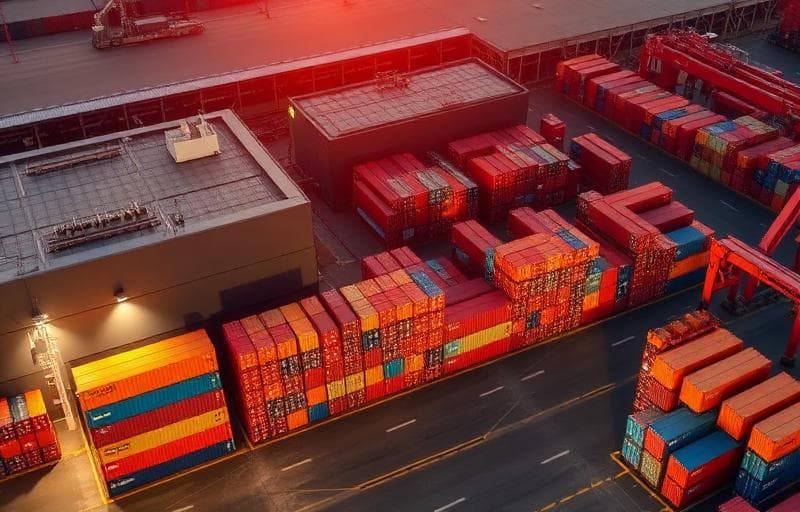
Global trade in India increasingly runs into the same friction point: getting close enough to buyers to be competitive, without loading up on the operational and cash-flow commitments each market needs individually. Free Trade Warehousing Zones offer a way through that problem. Beyond the duty and tax benefits most importers already know, an FTWZ works especially well as a base for re-export and regional distribution — letting a business bring goods into India, hold them under customs supervision, and route them onward to wherever demand actually is, rather than treating every shipment as a one-way trip into the domestic market.
Duty and Tax Treatment That Keeps Trade Flowing
Goods stored in an FTWZ are held under customs supervision and, subject to applicable regulations, do not attract customs duty until they are cleared into India's Domestic Tariff Area (DTA) or re-exported. An electronics importer bringing in a shipment of laptops, for example, does not need to pay duty on the full consignment at the point of arrival — duty becomes payable only on the portion that is actually moved into the domestic market, while the rest can continue to sit in the zone or be routed elsewhere.
For businesses trading across several countries, this matters more than it might first appear. Duty liability tracks actual market decisions rather than the shipping schedule, which keeps working capital available for the parts of the business that are still finding their buyer.
See CBIC's official customs resources →Location and Infrastructure Built for Cross-Border Flow
India's FTWZs are generally positioned near major ports, airports, and industrial corridors, which shortens the distance — and the time — between a shipment landing and it being ready to move again, whether that next move is into India or out to another market. Facilities typically include modern warehousing, temperature-controlled storage where needed, and handling equipment suited to a range of cargo types.
For a business using India as a staging point for regional trade, that proximity to gateway infrastructure is what makes fast turnaround realistic rather than theoretical.
Flexibility to Store, Split, and Redirect Shipments
One of the more practical advantages of an FTWZ is that a single consignment doesn't have to have a single destination. Goods can be held in the zone, re-exported in full, or split so that different portions are cleared into the domestic market or shipped onward to different countries as demand becomes clearer.
An FMCG company importing bulk raw materials illustrates this well. Rather than committing the entire shipment to one market on arrival, the company can store the consignment in the FTWZ and repackage it into smaller export-ready quantities as orders come in from different countries — avoiding the overstocking that comes from guessing demand too far in advance in any single region.
Value-Added Services That Prepare Goods for Export
Before goods move on to their next market, they often need work: relabelling to meet a destination country's regulations, repackaging into different unit sizes, sorting and consolidation across multiple shipments, or quality inspection to confirm products meet the standard a buyer expects. Subject to applicable regulations, these activities — along with kitting and CKD/SKD assembly of pre-made components into finished kits — can generally be carried out within the FTWZ itself.
Handling this inside the same customs-controlled facility means goods don't need to shuttle between separate storage and processing sites before they're export-ready, which simplifies both the logistics and the paperwork trail.
Visit DGFT, Ministry of Commerce & Industry →Using India as a Hub for Regional Expansion
For companies looking to grow beyond a single market, an FTWZ can function less like a warehouse and more like a forward operating base. A consumer electronics brand, for instance, might use an FTWZ in India as a hub for re-exporting products to South Asia and Africa — importing in bulk to one location, then distributing outward to multiple destinations as regional demand develops, rather than establishing separate storage and import arrangements in every country it sells into.
This is where the re-export flexibility of an FTWZ compounds with its location advantage: fewer points of friction between where goods land and where they're ultimately needed.
See official government FTWZ data (Lok Sabha, Ministry of Commerce & Industry) →How Long Goods Can Stay — and Why That's Useful
Storage in an FTWZ isn't unlimited, but it is generous enough to support real trading decisions rather than forcing them. Subject to applicable regulations, goods can typically remain in the zone for up to three years, extendable to five years with special permission. That window gives a business time to assess market conditions, secure buyers in multiple countries, or wait out unfavourable pricing — without the pressure of an imminent deadline forcing a rushed domestic clearance or export decision.
Related Topics
ftwz global tradeftwz re-export indiafree trade zone regional distributionftwz for exporters
Need FTWZ Warehousing or Freight Support?
Talk to our logistics experts — free consultation, no commitment.